The 4% Rule is Changing: How to Build a Modern FIRE Portfolio

Key Takeaway
The 4% rule was designed in 1994 using historical data from a completely different economic reality. In today's volatile markets, relying solely on a basic stock-and-bond mix could put your early retirement at massive risk. Here is how to modernize your portfolio for true financial independence.
For decades, the Financial Independence, Retire Early (FIRE) movement has treated the "4% Rule" as absolute law.
Developed by financial planner William Bengen in 1994, the rule states that if you withdraw 4% of your initial retirement portfolio balance each year (adjusted for inflation), your money is highly likely to last at least 30 years.
It’s an elegant, beautifully simple framework. But it has a glaring vulnerability: it was built for an economic climate that no longer exists.
Bengen’s original study relied heavily on a traditional retirement portfolio composed of 60% large-cap US stocks and 40% US government bonds.
Today, with shifting global dynamics, intense inflationary pressures, and unpredictable market cycles, a basic two-asset portfolio is facing unprecedented headwinds. If you want your nest egg to survive a 40-year or 50-year early retirement, your asset allocation needs an upgrade.
Why the Traditional 60/40 Mix is Straining
Historically, bonds acted as a reliable cushion when equities took a dive. But in recent inflationary periods, we have seen both stocks and bonds drop simultaneously. This correlation destroys the exact safety net that early retirees rely on to avoid the dreaded sequence of returns risk - the danger of a market crash occurring right after you stop working.
Furthermore, a 30-year horizon is fine for someone retiring at age 65. If you are aiming for financial freedom in your 30s or 40s, your portfolio needs to survive for half a century or more.
The Anatomy of a Modern, Diversified FIRE Portfolio
To achieve true resilience, modern early retirement portfolios are expanding beyond Wall Street’s standard menu. The goal is to build an allocation across assets that do not move in lockstep with one another.
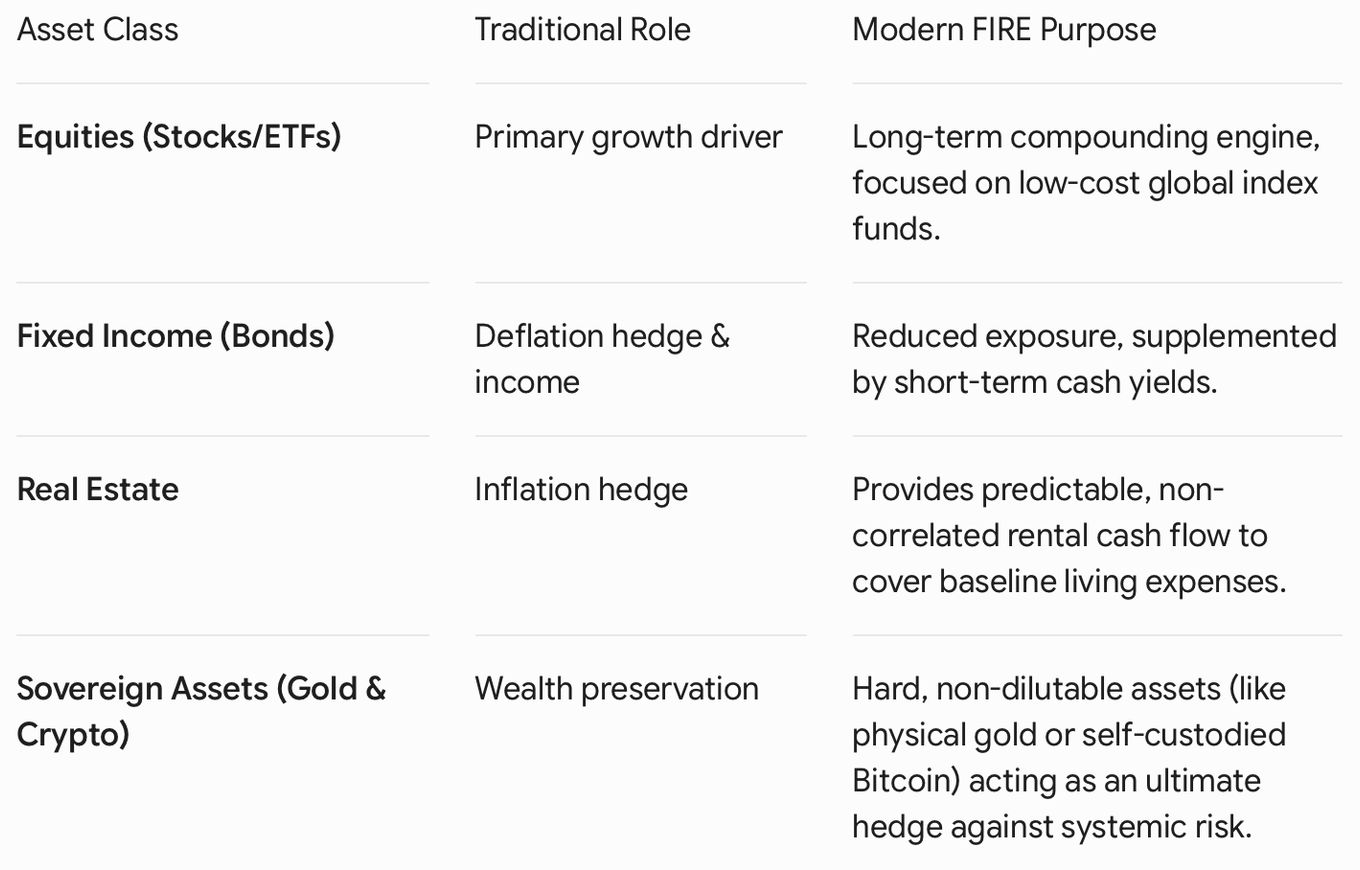
By weaving alternative, hard assets into your strategy, you reduce volatility and create multiple distinct buckets to draw from during market downturns. If stocks are down, you live off real estate income or trim a portion of your precious metals, letting your equities recover unharmed.
Track Internationally, Keep it Local
As your portfolio evolves to include global ETFs, real estate, precious metals, and public crypto addresses, tracking your true net worth becomes a chaotic puzzle.
Many investors make the mistake of solving this by signing up for complex cloud-based portfolio managers. They link their brokerages, upload their real estate deeds, and input their crypto balances. By doing so, they build a massive, centralized digital monument of their entire net worth on a corporate cloud server, creating a glaring target for hackers and identity thieves.
If you are building an independent, self-sovereign portfolio, your tracking tool should match your philosophy. You shouldn't have to sacrifice your personal data privacy just to see if your safe withdrawal rate is on track.
Before you make any drastic shifts in your career or portfolio design, it is essential to map out the math clearly. You can model your retirement timelines completely privately by using our suite of interactive, account-free DecentWealth FIRE and Retirement Calculators. Run your numbers, stress-test your withdrawal rates, and rest easy knowing your financial blueprint stays exactly where it belongs: on your own device.
Disclaimer: The information provided in this article is for educational and informational purposes only and does not constitute financial, investment, tax, or legal advice. Investing in financial instruments, including stocks, ETFs, cryptocurrency, and real estate, carries risk of loss. Always conduct your own research or consult with a licensed professional before making financial decisions.
Frequently Asked Questions
Is the 4% safe withdrawal rate still realistic for a 50-year US early retirement?
How do I build a diversified US FIRE portfolio to hedge against persistent inflation?
Can I track self-custodied Bitcoin and physical gold alongside my US index funds?
Is there a secure tool to calculate my US FIRE timeline?
How does DecentWealth handle portfolios with international assets or multiple currencies?
Disclaimer
Track your portfolio privately
Stocks, crypto, real estate, and more. No account required.