Free Financial Calculators
Four calculators for individual investors: compound growth, financial independence, dividend reinvestment, and retirement planning. Free, private, and instant. No account required.
Investment Calculator
See how a starting balance grows with monthly contributions and compound interest. Model any time horizon from 1 to 50 years and separate what you contributed from what the market added.
FIRE Calculator
Find your Financial Independence number and the exact year you can stop working. Enter your annual expenses and savings rate to see how far away financial independence really is.
Dividend DRIP Calculator
Model how dividend reinvestment compounds your share count and annual income over time. See the total dividends collected and the split between contributions and DRIP gains.
Living Off Dividends Calculator
Work out the capital you need before dividends alone cover your living costs, and the year your portfolio gets there. The income-based counterpart to a FIRE number.
Retirement Calculator
Enter your retirement age, current savings, and planned expenses to see your portfolio at retirement and how long it will last. The two-phase chart shows accumulation and drawdown together.
Your strategy is ready. Now execute it privately.
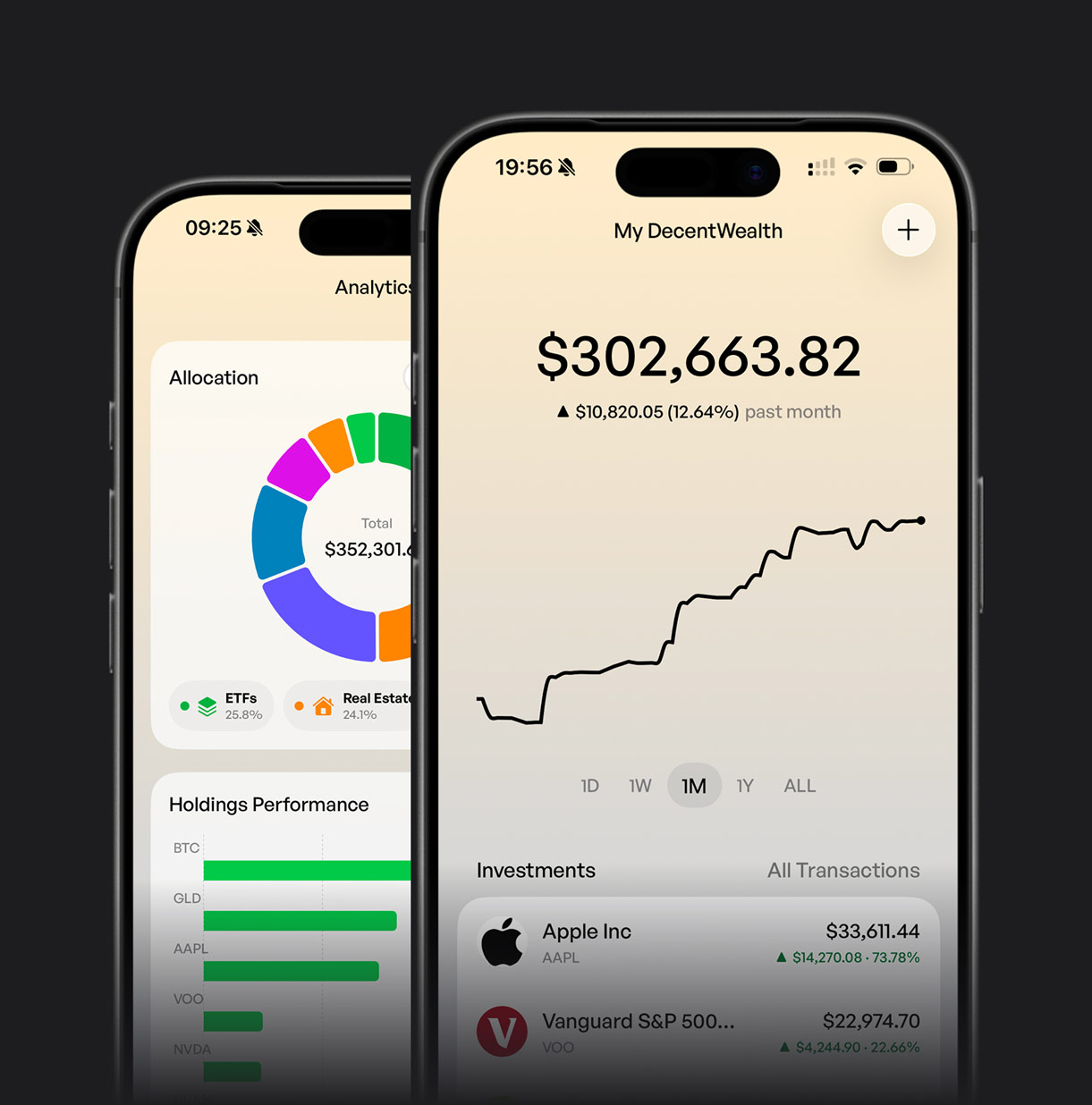
DecentWealth tracks your real portfolio on your iPhone, with no accounts, no syncing, and no data sent anywhere. Your numbers stay on your device.


Which calculator should you use?
Each calculator answers a different financial question. Use this guide to pick the right one for your situation.
If you want to know: how much will this investment grow?
Use the Investment Calculator. Enter any starting balance, monthly addition, and expected return rate to see a compound growth projection.
If you want to know: when can I stop working?
Use the FIRE Calculator. It calculates your Financial Independence number and shows exactly how many years your current savings rate will take to get you there.
If you want to know: how much income will my dividends generate?
Use the Dividend DRIP Calculator. It models how reinvesting dividends compounds your share count and annual income, separate from price appreciation.
If you want to know: will my savings last through retirement?
Use the Retirement Calculator. It models both the accumulation phase and the drawdown phase, showing the age at which your savings are projected to run out.
How these calculators work
All four calculators run entirely in your browser using standard financial mathematics. There is no backend, no server call, and no delay. The moment you move a slider, the result updates.
The Investment, FIRE, and Dividend calculators use compound growth: each year's balance earns a return on itself, not just on your contributions. The Retirement Calculator adds a second phase where the portfolio depletes at your planned withdrawal rate, letting you see savings longevity alongside growth.
None of your inputs are stored or sent anywhere. You can open the browser developer tools, disable network access, and every calculator will continue to work identically.
What return rate should you assume?
The S&P 500 has returned an average of approximately 10% per year since 1957, before inflation. After adjusting for inflation, the real return is closer to 7%. Most financial planners use 6-8% as a long-term planning assumption for a diversified portfolio of stocks.
For a portfolio that mixes stocks and bonds, a 5-6% assumption is more appropriate. For post-retirement drawdown, when most investors shift to a more conservative allocation, 4-5% is a reasonable default.
These are planning assumptions, not guarantees. Markets are volatile year-to-year; these calculators model a smooth average return. The results are best used to compare scenarios and understand the leverage that time and savings rate have on outcomes, not to predict an exact future balance.
Frequently asked questions
Common questions about financial calculators and how to use them.
What is the difference between an investment calculator and a retirement calculator?
An investment calculator answers: how much will my money grow? You enter a starting balance, monthly contribution, return rate, and time horizon, and it projects a final balance. A retirement calculator models two separate phases: accumulation (working years) and drawdown (retirement years). It answers: will I have enough by my target retirement age, and how long will my savings last before they run out?
What is a FIRE number?
Your FIRE number is the portfolio size at which you can stop working and live indefinitely off investment returns. It is calculated as your annual expenses divided by your safe withdrawal rate. At the standard 4% withdrawal rate, your FIRE number equals 25 times your annual expenses. Someone spending $60,000 per year needs $1,500,000 to be financially independent at 4%.
What is dividend DRIP?
DRIP stands for Dividend Reinvestment Plan. Instead of receiving dividend payments as cash, a DRIP automatically uses those payments to purchase additional shares of the same investment. This creates a compounding effect: more shares generate more dividends, which buy even more shares. Over long holding periods, reinvested dividends often account for the majority of total return in dividend-focused portfolios.
Which calculator should I use to plan for early retirement?
Use the FIRE Calculator if your main question is: when can I retire? It calculates your target number and how many years your current savings rate will take to reach it. Use the Retirement Calculator if your main question is: will my savings last? It lets you set a fixed retirement age and models whether your portfolio will last to your life expectancy or run out early.
What return rate should I use in a financial calculator?
For a diversified stock portfolio, most planners use 6-8% as a long-term assumption after inflation. The S&P 500 has averaged approximately 10% annually since 1957, or about 7% after adjusting for inflation. For a balanced portfolio of stocks and bonds, 5-6% is appropriate. For the drawdown phase of retirement, when your allocation is typically more conservative, use 4-5%.
Are these calculators accurate?
These calculators use correct financial formulas and are accurate for the assumptions they model. The key limitation is that they assume a constant annual return rate, while actual markets are volatile year-to-year. The output is best used to compare scenarios and understand the impact of time, savings rate, and return assumptions, not to predict an exact future balance.
Is my financial data private?
Yes. All calculations run entirely in your browser. No inputs, results, or usage data are sent to any server. There are no accounts to create and nothing is stored. You can disable your internet connection and every calculator will continue to function identically.
Are these calculators free?
Yes. All four calculators are completely free with no account, no email, and no payment required at any point.