How to Invest in Gold in 2026: ETFs, ETCs, Stocks, and the Bars You Can Hold and Track

Key Takeaway
There are four practical ways to own gold, each with its own trade-offs. Gold ETFs (like GLD or IAU) are the easiest, you buy them in your brokerage and they track the spot price. Gold ETCs are the European cousin, an exchange-traded commodity that fills the gap where US gold ETFs aren't available. Gold stocks (miners like Newmont, royalty companies like Franco-Nevada, or a fund like GDX) give you leverage to the gold price plus company risk and the occasional dividend. Physical gold, coins and bars, is the one with no counterparty: nobody can freeze it, but you do have to store it and insure it. The smart money has noticed all of this. At the end of 2025, gold became the largest reserve asset held by the world's central banks, and even a stablecoin issuer started stacking bullion. The catch with physical gold has always been tracking it. DecentWealth now supports Gold, Silver, Platinum, and Palladium as first-class assets, with live spot prices that update hourly and never touch our servers.
Gold has spent decades with an image problem. It was the thing your most pessimistic relative wouldn't stop talking about, filed somewhere between "off the grid" and "told you so." Useful, but not exactly a serious portfolio decision.
Lately the people who manage actual reserves seem to disagree.
At the end of 2025, gold did something it hadn't done since 1996: it overtook US Treasuries as the single largest reserve asset held by the world's central banks.
According to a European Central Bank report, bullion climbed to 27% of global central bank reserves, up from 20% a year earlier, while the US Treasury share slipped from 25% to 22%.
The biggest buyers since 2022 have been China, Poland, Turkey, and India, and they kept buying even as prices hit record highs.
Stranger still, the single largest gold buyer in some recent quarters wasn't a country at all. It was Tether, the company behind the world's biggest stablecoin, which now holds well over 100 tonnes of the stuff, enough to rank it alongside mid-sized central banks.
When a crypto company and the People's Bank of China land on the same idea, it's usually worth a look.
1. Gold ETFs: The Path of Least Resistance
A gold ETF is a fund that holds physical gold in a vault and issues shares that track its price. You buy them through the same brokerage where you hold your stocks. The two giants in the US are SPDR Gold Shares (GLD) and iShares Gold Trust (IAU).
The appeal is obvious. No vault, no insurance, no shipping, no spread-eyed coin dealer. One ticker, instant liquidity, and your gold exposure shows up next to your index funds. For most people who just want gold to be part of the mix, this is the simplest answer.
- First, you don't own gold, you own a claim on a fund that owns gold. That's a fine arrangement right up until it's exactly the arrangement you were trying to avoid.
- Second, in the US, physically-backed gold ETFs are generally taxed as "collectibles," which can mean a higher long-term capital gains rate than you'd pay on stocks. Numbers like that move around, so this is a "ask your tax person, not a blog" situation.
2. Gold ETCs: The European Cousin Nobody Introduces You To
If you're investing from Europe, you may have noticed that US gold ETFs are politely unavailable to you, thanks to a wall of regulation with cheerful names like PRIIPs and MiFID. The European answer is the gold ETC, an Exchange-Traded Commodity.
An ETC is technically a debt security rather than a fund, but the good ones are fully backed by physical metal sitting in a vault, often with the option to redeem it for actual bars if you ever feel the urge.
Popular physically-backed examples include Xetra-Gold, Invesco Physical Gold, and WisdomTree Physical Gold. They trade on European exchanges just like a stock, in euros, with no account at a precious-metals dealer required.
For a European investor, an ETC does the same job a gold ETF does for an American one: clean, liquid exposure that lives inside your regular brokerage. Same idea, different paperwork, friendlier to a portfolio built under European rules.
3. Gold Stocks: Gold With a Caffeine Problem
You can buy shares in the companies that dig gold out of the ground (miners like Newmont, Barrick, or Agnico Eagle), the companies that finance them in exchange for a cut (royalty and streaming firms like Franco-Nevada or Wheaton Precious Metals), or a basket of them through an ETF like GDX or GDXJ.
When gold rises 10%, a well-run miner's profits can jump much more than 10%, because their costs are roughly fixed and the extra goes straight to the bottom line. Some of these companies even pay dividends, which is something a gold bar has never once done for anyone.
The catch is that you're no longer just betting on gold. You're betting on management, mining costs, a flood in the wrong pit, a government in the wrong country, and a balance sheet.
Gold stocks can fall while gold rises, which tends to surprise people exactly once. Treat them as equities that happen to be correlated with gold, not as gold itself.
4. Physical Gold: The One Nobody Can Switch Off
Then there's the original. Coins like the American Gold Eagle, the Canadian Maple Leaf, or the Krugerrand. Bars from recognized refiners. The kind of gold you can hold in your hand and, if you're feeling dramatic, bite.
The entire case for physical gold is the absence of a middleman. There's no fund, no ticker, no platform, no counterparty who can have a bad quarter or a frozen account. It's the financial equivalent of cash that doesn't care what any company thinks. In a year when central banks are stacking bullion specifically because it can't be sanctioned or switched off, that argument lands differently than it used to.
The trade-offs are real and physical. You'll pay a premium over the spot price when you buy, and accept a slightly lower price when you sell (that gap is the dealer's lunch).
You have to store it somewhere that isn't an obvious sock drawer, and insure it. And it's the least liquid option on this list, because selling a coin is a phone call and a drive, not a tap.
But there's one more trade-off that has quietly annoyed every physical-gold owner forever: tracking it. Your ETF shows up in your brokerage. Your bars show up in a drawer and, until now, in a "static manual property field" that you had to update by hand every time the gold price moved. Which is to say, never.
We fixed that.
Track Gold, Silver, Platinum, and Palladium in DecentWealth
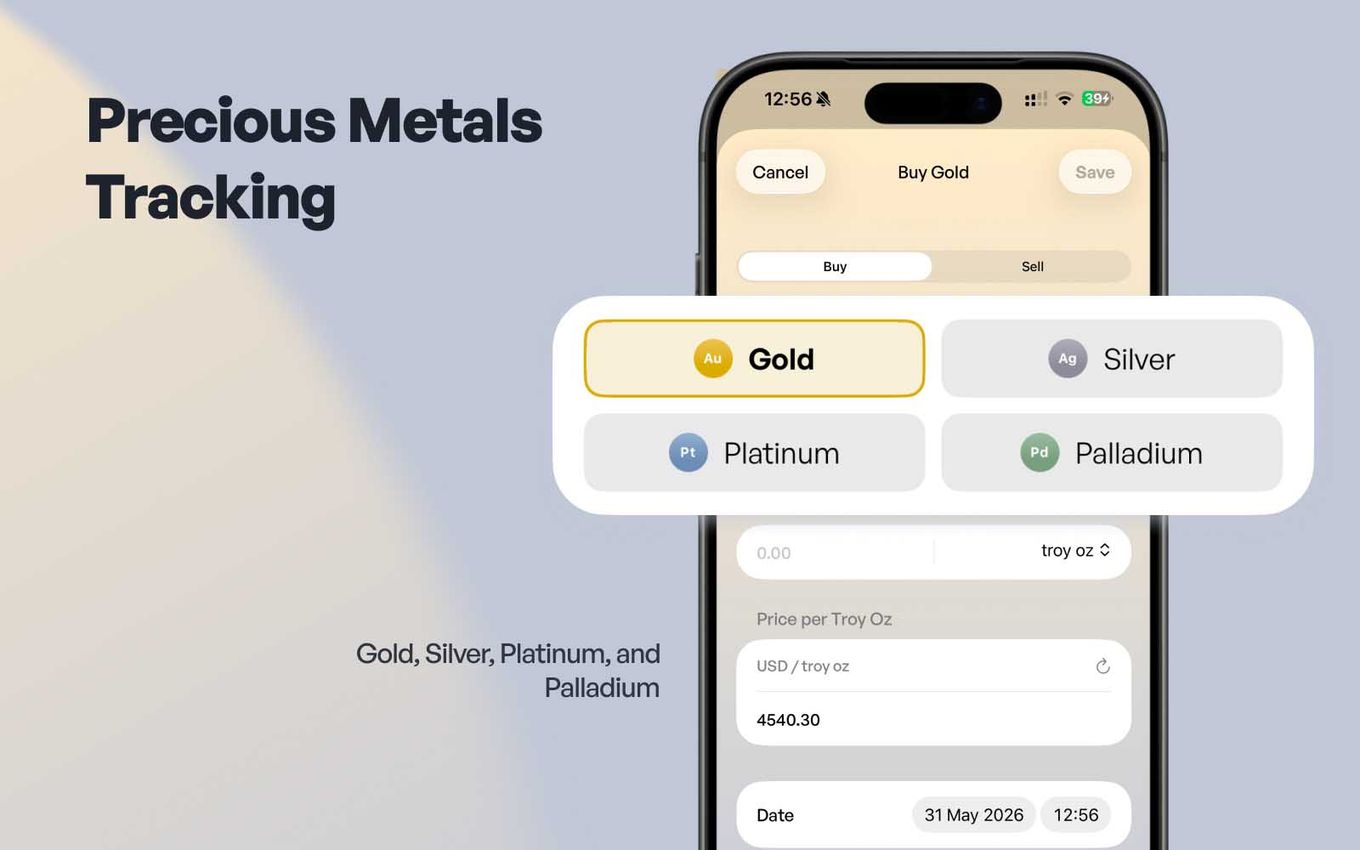
Gold, Silver, Platinum, and Palladium are now first-class assets in DecentWealth. If you hold physical metal as part of a diversified, all-weather portfolio, you no longer have to manage your bullion through awkward workarounds or a manual field that's wrong by lunchtime.
- Streamlined, automatic valuations. Enter your holdings once. DecentWealth fetches live spot prices updated every single hour, with no API key to set up, no premium paywall, and no sitting through delayed data. You enter weight in troy ounces, grams, or kilograms, and the app handles every conversion under the hood instantly.
- It shows up in your net worth. Your metals populate your portfolio allocation chart as their own distinct category, sitting cleanly next to your stocks and crypto. So when you finally answer the question "what am I actually worth across everything," your gold is in the picture instead of in a separate spreadsheet you keep meaning to update.
- And here's the part that matters for the way DecentWealth is built. This feature runs on the same privacy-first architecture as everything else in the app. All commodity prices are pulled directly by your device from a public API. Your total net worth and exactly how much metal you're sitting on stay strictly on your device.
- That last point is the whole personality of this app. There's a certain irony in buying gold for privacy and self-custody, the asset that nobody can track, and then logging it into a tracker that uploads your holdings to a company server. We're not going to do that to you. Gold that nobody can switch off deserves a tracker that nobody else can read.
How to See Your Whole Picture in One Place
Whichever route you take, gold rarely lives alone. You've probably got the ETF in your brokerage, maybe an ETC if you're investing from Europe, a couple of mining stocks, some coins in a safe, and a crypto wallet doing its own thing in the corner. Five apps, four logins, and one nagging feeling that you don't actually know your number.
That's the problem DecentWealth was built for. It pulls stocks, ETFs, crypto across 16 blockchains, real estate, retirement accounts, cash, and now precious metals into a single view of your net worth on iPhone, iPad, and Apple Watch. No account, no email, no server storing your holdings.
If you're just sizing things up, the Investment Calculator lets you model how a gold allocation changes your projections, with no email and no "we'll send your results to your inbox" trick.
And when you're ready to track the real thing, download DecentWealth and add your first bar in under a minute.
__________________________________________________________________________________
This article is general information, not personalized investment advice. Gold prices move, tax rules vary by country, and we're a portfolio tracker, not your financial advisor. Do your own homework, and talk to a professional before making decisions about your money.
Frequently Asked Questions
Can DecentWealth track gold, silver, platinum, and palladium?
What's the easiest way for a beginner to invest in gold?
How does DecentWealth price my gold?
Does DecentWealth track the exact coins or bars I own?
Can I see how gold fits into my overall allocation?
What happens to my metal holdings when I'm offline?
Track your portfolio privately
Stocks, crypto, real estate, and more. No account required.