Investment Calculator
See how your money grows over time with the power of compound interest. Enter your numbers below and get a projection instantly, with no account and no data sent anywhere.
Investment details
The amount you are starting with today.
How much you plan to add each month.
The S&P 500 has averaged 10.2% annually since 1957. Use 6-8% for a conservative estimate.
For most stock and ETF investments, monthly is a realistic assumption.
Final balance
$300,851
Total contributed
$130,000
Interest earned
$170,851
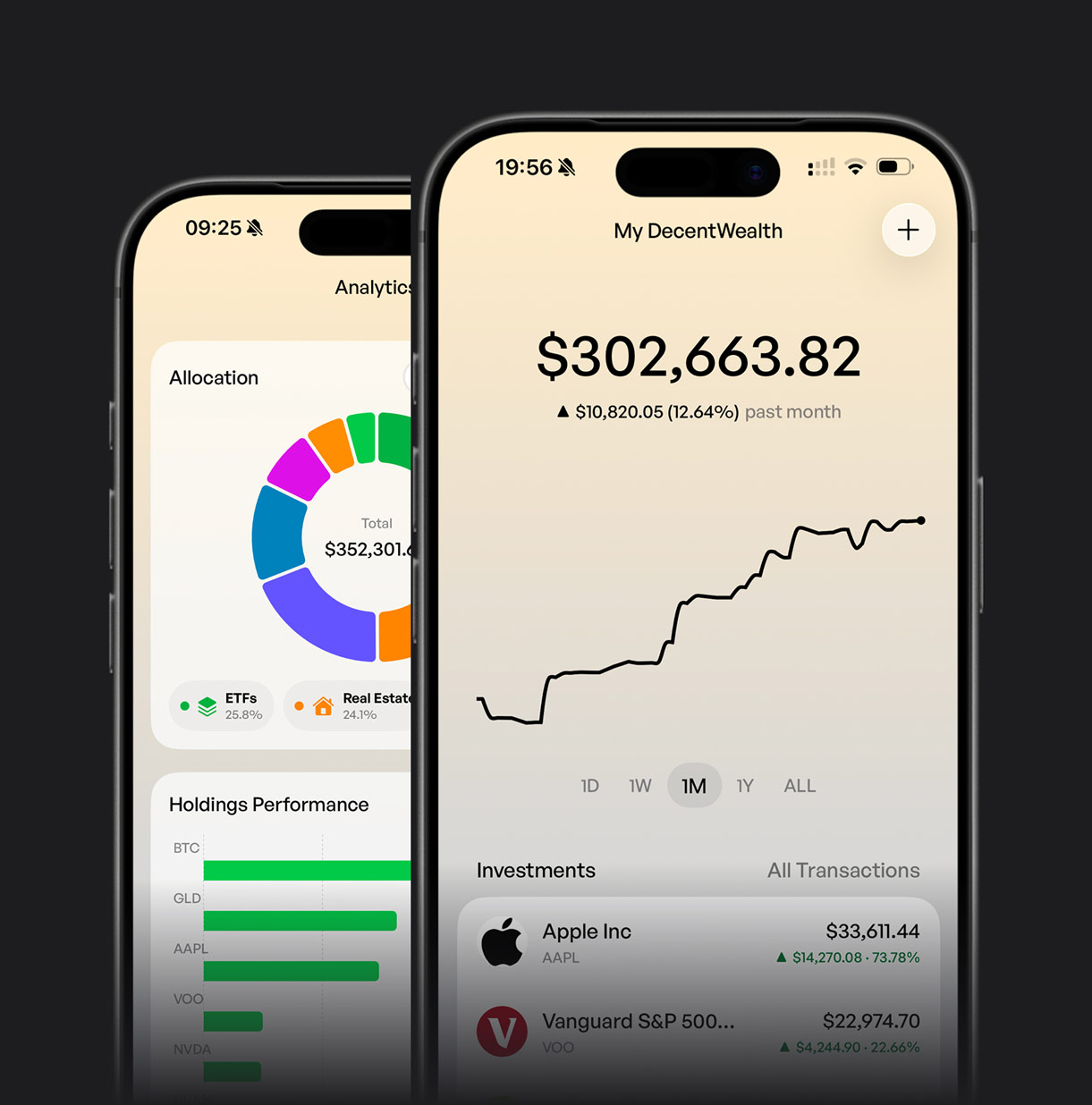
Your strategy is ready. Now execute it privately.
DecentWealth tracks your real portfolio on your iPhone, with no accounts, no syncing, and no data sent anywhere. Your numbers stay on your device.


How to use this investment calculator
Enter four numbers: your starting balance, what you plan to add each month, the annual return you expect, and how many years you want to model. The calculator updates your projection in real time.
The result shows your final balance, the total amount you contributed yourself, and the interest your investments earned on top of that. The difference between those last two numbers is the compounding effect at work.
What rate of return should I use?
The right rate depends on what you plan to invest in.
According to research from NYU Stern, the S&P 500 has returned an average of 10.2% annually since 1957. After adjusting for inflation, that figure drops to roughly 7.2%. For a diversified portfolio of stocks and bonds, most financial planners use 6-8% as a planning assumption.
If you invest in a money market account or bonds, 3-5% is more realistic. For most long-term investment planning, 7% is a reasonable middle ground.
Why compound interest matters more than the amount you invest
Compound interest means you earn returns on your returns, not just on your original investment. Over long time horizons, this effect becomes the dominant driver of your final balance.
Consider two investors. The first invests $200 per month starting at age 25. The second invests $400 per month starting at age 35. Both assume a 7% annual return and retire at 65. The first investor contributes $96,000 total. The second contributes $144,000 total. At retirement, the first investor ends up with approximately $525,000. The second ends up with approximately $484,000.
Starting earlier, even with half the monthly contribution, produces a larger final result. That is the compounding effect in practice.
Common questions
What is an investment calculator?
An investment calculator is a tool that estimates how much a sum of money will grow over time based on your initial investment, regular contributions, expected return rate, and time horizon. It uses the compound interest formula to model growth, showing you both your total balance and the breakdown between money you contributed and returns earned on that money.
How much do I need to invest to become a millionaire?
At a 7% annual return, a $500 monthly investment starting from zero reaches $1 million in approximately 37 years. If you already have $10,000 invested, you reach $1 million in about 34 years with the same monthly contribution. Starting earlier or contributing more shortens the timeline significantly. You can test any combination in the calculator above.
What is a realistic rate of return for long-term investing?
For a diversified portfolio of low-cost index funds, most financial planners use 6-8% as a real-world planning assumption after inflation. The S&P 500 has averaged 10.2% annually since 1957 before inflation, according to data from NYU Stern School of Business. For a conservative retirement plan, 6% is a reasonable assumption. For modeling optimistic scenarios, 9-10% is commonly used.
How does compound interest work?
Compound interest means you earn returns on your returns, not just on your original investment. If you invest $10,000 at 7% annual return, you earn $700 in year one. In year two, you earn 7% on $10,700, which is $749. Each year, the base grows, and so does the return. Over 30 years at 7%, your $10,000 becomes approximately $76,000 without adding a single additional dollar. That growth comes entirely from compounding.
Should I invest a lump sum or monthly contributions?
Research consistently shows that investing a lump sum as early as possible outperforms spreading the same amount over time, because the full principal benefits from compounding sooner. However, monthly contributions from income is the practical approach for most investors. The best strategy is the one you can consistently follow.
Is this investment calculator free?
Yes. This calculator is completely free to use and requires no account or signup. All calculations run directly in your browser, which means your numbers are never sent to our servers or stored anywhere.
How accurate are investment calculators?
Investment calculators model a simplified version of reality. They assume a constant annual return, which actual markets do not provide. Real portfolios experience year-to-year volatility. Calculators are useful for goal-setting and understanding the impact of time, contributions, and return rates, not for predicting exact future values.
What is the difference between this and a FIRE calculator?
A standard investment calculator answers: how much will my money grow? A FIRE calculator (Financial Independence, Retire Early) answers: how much do I need to reach financial independence, and when will I get there? The FIRE calculator incorporates your annual expenses, target withdrawal rate, and savings rate to estimate your independence date. Use this calculator to model a specific investment. Use the FIRE calculator to plan your full retirement picture.
More financial calculators
FIRE Calculator
Find your Financial Independence number and see exactly when you can retire early based on your savings rate and expenses.
Try itDividend DRIP Calculator
See how reinvesting dividends grows your income and share count over time. Enter any ticker or set your own yield manually.
Try itRetirement Calculator
Calculate how much you need to save to retire comfortably at your target age, accounting for inflation and expected withdrawals.
Try it