Retirement Calculator
See how much you will have saved by your target retirement age, how long that money will last, and whether your current plan gets you there. Enter your numbers below for an instant two-phase projection, with no account and no data sent anywhere.
Retirement details
The age at which you plan to stop working and start drawing down savings.
Total invested assets today: 401(k), IRA, brokerage, index funds.
How much you invest each month until retirement.
Your expected yearly spending once retired. Determines how fast your portfolio depletes.
Pre-retirement growth rate. Use 7% for a diversified index fund portfolio.
Return on your portfolio after retiring. Lower than pre-retirement due to a more conservative allocation.
Used to model how long your savings need to last. Planning to 90 covers most scenarios.
Portfolio at retirement
$1,444,969
Savings last through
Age 90+
Outlasts life expectancy
Monthly income needed
$4,167
From your portfolio
Your strategy is ready. Now execute it privately.
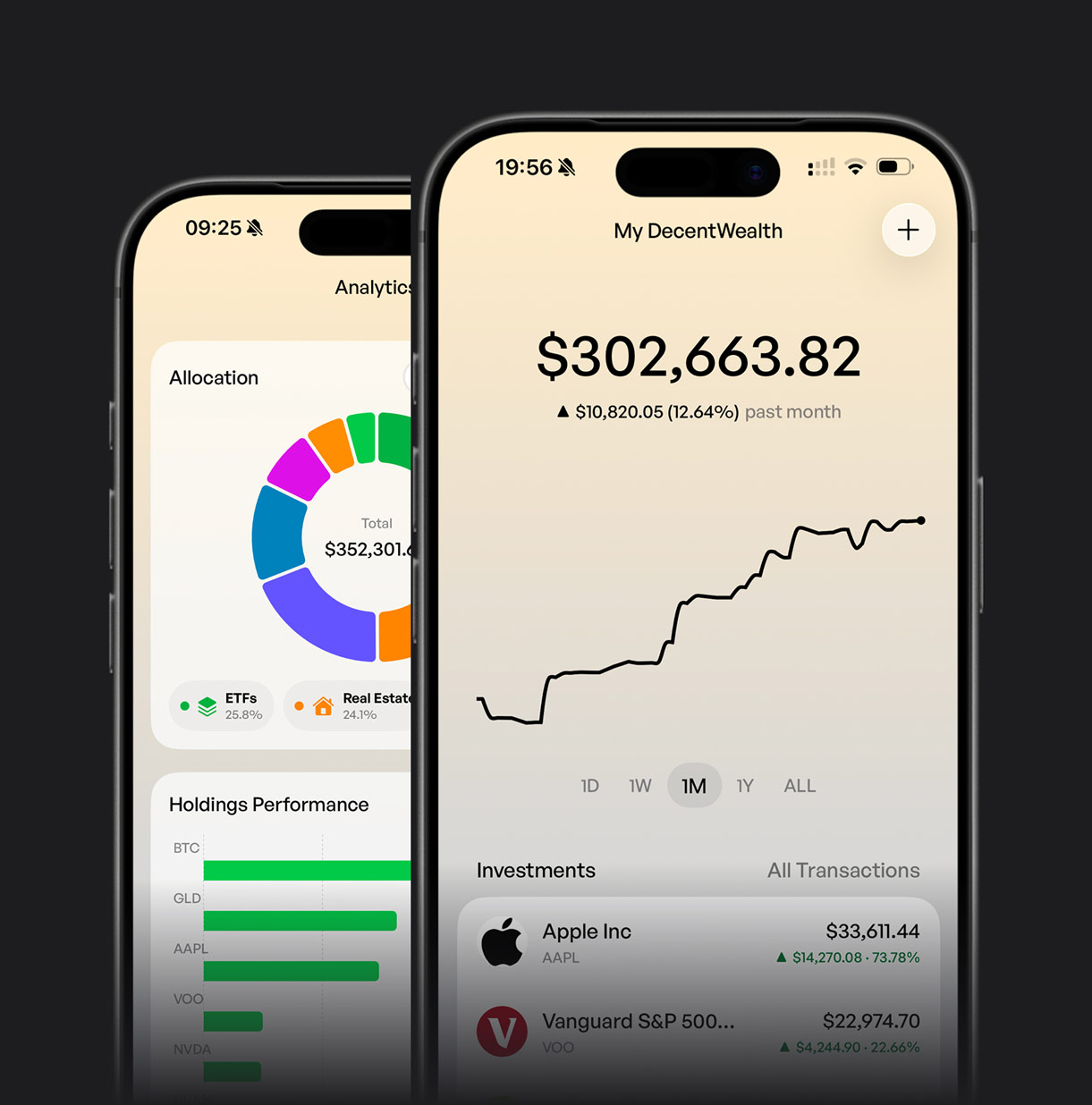
DecentWealth tracks your real portfolio on your iPhone, with no accounts, no syncing, and no data sent anywhere. Your numbers stay on your device.


How to use this retirement calculator
Enter your current age, your target retirement age, your current savings, what you plan to contribute each month until retirement, your expected annual expenses in retirement, and your pre-retirement return rate. The calculator shows how large your portfolio will be at retirement and models the drawdown phase to tell you whether your savings will last through your life expectancy.
Use the advanced options to set a separate post-retirement return rate (typically lower, due to a more conservative allocation) and to adjust your life expectancy assumption. Setting life expectancy to 95 or 100 is a conservative choice that accounts for longevity risk without requiring you to predict exactly how long you will live.
Accumulation vs drawdown: the two phases of retirement
Retirement planning involves two distinct financial phases. The accumulation phase covers your working years: you contribute monthly, your portfolio grows, and compound interest does most of the heavy lifting over time. The longer this phase lasts, the larger the balance you carry into retirement.
The drawdown phase begins when you retire. You stop contributing and start withdrawing. Your portfolio still earns returns on the remaining balance, but each annual withdrawal reduces the principal. The rate at which you spend relative to your balance determines how long the money lasts.
The chart above shows both phases in sequence. The dark area is accumulation. The green area is drawdown. The peak, where the two meet, is your portfolio at retirement. If the green line reaches zero before your life expectancy, your savings run out. If it stays positive, your plan is on track.
What return rate should you use in retirement?
Most financial planners recommend a lower return assumption in retirement than during your working years. The reason: retirees typically shift toward a more conservative portfolio with a larger allocation to bonds and stable assets, accepting lower returns in exchange for lower volatility.
A common planning assumption for a balanced retiree portfolio (60% stocks, 40% bonds) is 4% to 6% per year. The default in this calculator is 5%. If you plan to maintain a more aggressive portfolio in retirement, you might use 6% to 7%. If you plan to shift heavily toward bonds or stable income assets, 3% to 4% is more realistic.
Note that a higher post-retirement return significantly extends how long your savings last. Adjusting this slider alongside the annual expenses input is the most effective way to model whether your plan is sustainable.
Common questions
How much do I need to retire?
The most common rule of thumb is to accumulate 25 times your annual expenses by retirement, which supports a 4% annual withdrawal rate. If you plan to spend $50,000 per year, you need approximately $1,250,000. For longer retirements of 30 or more years, many planners recommend 28 to 33 times expenses, corresponding to a 3% to 3.5% withdrawal rate.
What is the difference between a retirement calculator and a FIRE calculator?
A FIRE calculator answers: when can I retire, given my savings rate? The retirement date is calculated based on your inputs. A retirement calculator answers: will I have enough by a specific target age, and how long will my savings last in retirement? This calculator assumes a fixed retirement date and models both the accumulation and drawdown phases. Use the FIRE calculator if your goal is to find the earliest possible retirement date.
What return rate should I expect after retirement?
Most financial planners recommend using a lower return assumption in retirement than during your working years, because retirees typically shift toward a more conservative portfolio. A common assumption is 4% to 6% for a balanced retiree portfolio. The default in this calculator is 5%, which reflects a moderate mix of stocks and bonds. Adjust it based on how you plan to invest your savings in retirement.
How long should I plan my retirement to last?
A common planning assumption is to age 90, which covers most scenarios without excessive over-saving. If longevity runs in your family or you retire early, planning to 95 or even 100 is prudent. Running out of money in your 80s is a serious risk: it is safer to over-plan and potentially leave a small estate than to under-plan and exhaust savings while still alive.
What if my savings run out before I die?
If the calculator shows your savings depleting before your life expectancy, you have several levers: save more each month, retire later, reduce planned expenses, or accept a higher withdrawal rate with the understanding that you may need to cut spending in later years. Social Security, pension income, or part-time work in early retirement can also extend how long your portfolio lasts.
Should I use pre-tax or post-tax numbers?
For simplicity, use after-tax numbers throughout: your current savings in after-tax terms, your monthly contributions in after-tax dollars, and your annual expenses as the amount you actually plan to spend. If most of your savings are in a traditional 401(k) or IRA, your withdrawals will be taxed as ordinary income. In that case, reduce your post-retirement return to account for taxes, or increase your annual expenses figure to reflect the gross withdrawal needed.
How does inflation affect my retirement savings?
Inflation erodes the purchasing power of fixed withdrawals over time. A $50,000 annual budget today buys less in 20 years at 3% inflation. This calculator uses nominal returns and nominal expenses without explicit inflation adjustment. To account for inflation conservatively, reduce your expected returns by 2 to 3 percentage points, which effectively converts them to real (inflation-adjusted) returns.
Is my data saved or sent anywhere?
No. This calculator runs entirely in your browser. Your financial numbers are never sent to our servers, stored in a database, or shared with any third party. You can use it freely without creating an account.
More financial calculators
Investment Calculator
See how your money grows over time with compound interest. Enter your starting amount, monthly contribution, and return rate for an instant projection.
Try itFIRE Calculator
Find your Financial Independence number and see exactly when you can retire early based on your savings rate and annual expenses.
Try itDividend DRIP Calculator
See how reinvesting dividends grows your income and portfolio value over time through the compounding effect.
Try it