Living Off Dividends Calculator
Work out how much capital you need before dividends alone cover your living costs, and the year your portfolio gets there. Enter your target income and your yield, and the answer updates instantly, with no account and no data sent anywhere.
Income target
What your dividends need to cover each month after tax.
Annual payout as a share of portfolio value. This input moves the answer more than any other.
What you already hold in dividend-paying assets.
Added each month. Dividends are reinvested until the target is reached.
How much the dividend per share rises each year, independent of price.
Set equal to dividend growth to hold the yield steady. Set higher and the yield drifts down.
Applied to every payout. Rates depend on your country, so check yours before relying on the result.
Raises your income target every year. Leave at 0% to answer in today's money.
Capital required
$1,028,571
Dividends cover your target in
22 years
At your contribution rate
Your dividend income today
$1,750
Per year, after tax
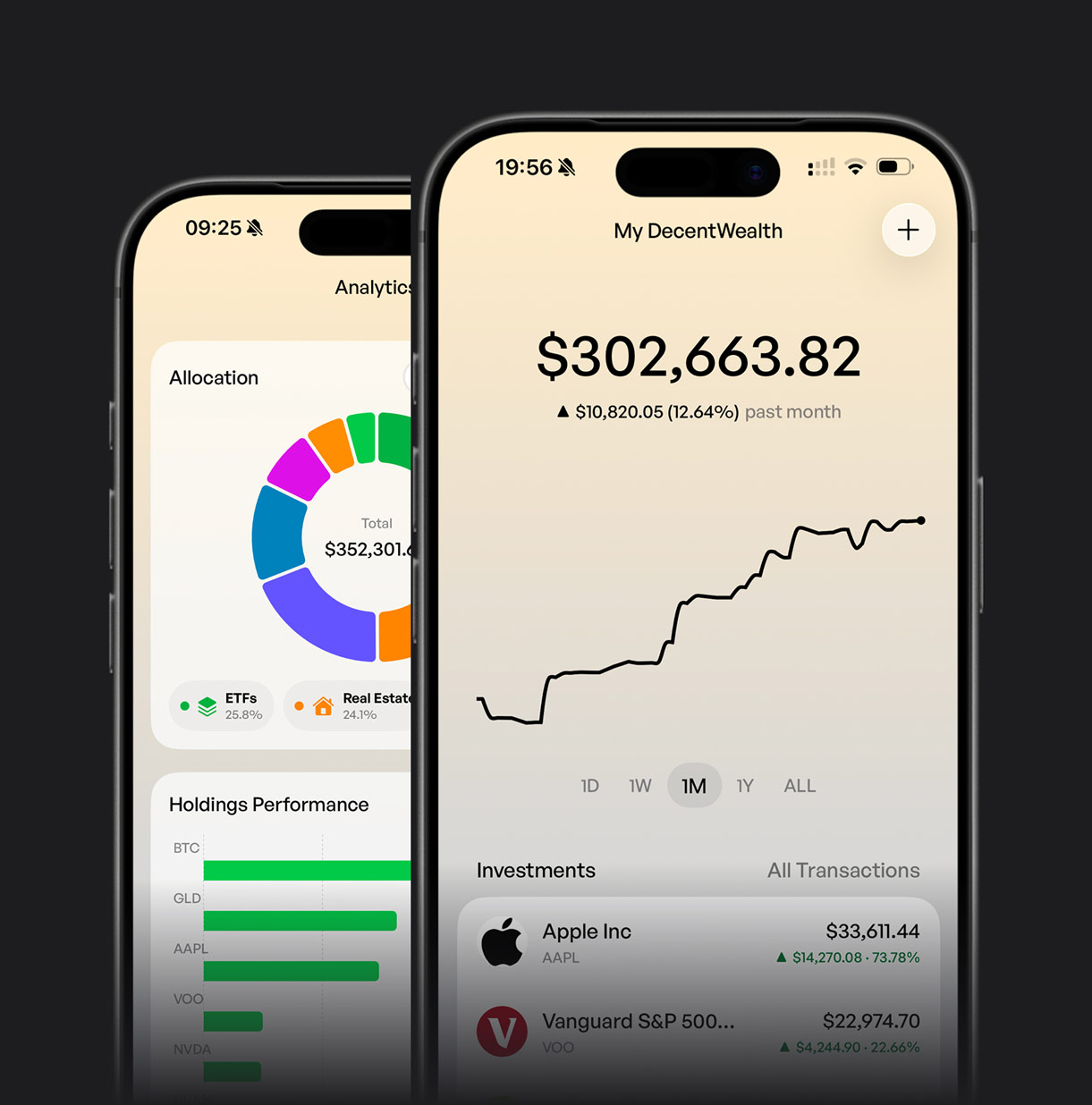
You have the number. Now track the gap privately.
DecentWealth shows your real dividend income and net worth on your iPhone, with no account, no bank login, and no data sent anywhere. Your numbers stay on your device.


How to use this living off dividends calculator
Enter the monthly income your dividends need to cover, the yield you expect to hold across the portfolio, what you have invested today, and what you add each month. The headline figure is the capital required: your annual income target divided by your net yield. Everything below it answers the second question, which is when you get there.
The projection reinvests every payout until the target is met, adds your monthly contributions, and grows the dividend per share and the share price at the rates in the advanced options. The chart shows annual dividend income against your target, and the year the two lines cross is the year the portfolio starts paying for your life.
This is not your FIRE number, and the difference matters
A FIRE number is a withdrawal calculation. You pick a withdrawal rate, commonly 4%, multiply your annual spending by 25, and plan to sell assets each year to fund your life. The capital is consumed on purpose, and the question the plan has to survive is whether it lasts long enough.
A dividend income target is a yield calculation. You spend only what the portfolio pays out, so nothing is sold and the capital is not drawn down. At a 4% withdrawal rate and a 3.5% yield the two numbers are close, which is why they get confused. At a 2% yield they are nowhere near each other, and the dividend version needs roughly twice the capital.
They also fail differently. A withdrawal plan fails by running out of money. A dividend plan fails by having its income cut, which is a smaller failure and a recoverable one, but it arrives without warning. Neither is safer in the abstract. If you want the withdrawal version of this question, use the FIRE calculator instead.
Why the yield you assume matters more than anything else
The capital you need is your income target divided by your yield, so the yield sits in the denominator and small changes swing the answer hard. Thirty six thousand dollars a year needs about $1,028,571 at a 3.5% yield, $720,000 at 5%, and $1,800,000 at 2%. No contribution schedule compensates for guessing this wrong.
The temptation is to solve the problem by assuming a high yield. Be careful with that: yield is the payout divided by the price, so it also rises when the price falls. A portfolio built for maximum current yield tends to have little dividend growth left to lift income later, and a payout that gets cut takes the plan with it.
This is what the two growth inputs are for. Set dividend growth equal to price appreciation and the yield stays where you put it. Set dividend growth higher and your yield on the portfolio climbs year after year, which is the mechanism that gets a low-yield, high-growth portfolio to the target faster than the headline yield suggests. Set price appreciation higher and the opposite happens: the portfolio value races ahead while the income lags.
Tax, and why it raises the number
Dividends are usually taxed in the year they are paid, whether you spend them or reinvest them. That has two effects here. It reduces the amount available to reinvest, which slows the compounding, and it means the portfolio has to produce more gross income to deliver the same spendable amount. Both push the capital requirement up.
The calculator applies your rate to every payout, so the target it reports is income you can actually spend. Rates and allowances vary by country and by personal circumstance, and they change. Set the rate to 0% only if you are modelling an account where dividends genuinely compound untaxed. This page is general information and not tax advice, so confirm your own position with a qualified advisor before planning around it.
Common questions
How much do I need invested to live off dividends?
Divide the annual income you need by your portfolio's dividend yield. At a 3.5% yield, $36,000 a year requires about $1,028,571 invested. At 5% the same income needs $720,000, and at 2% it needs $1,800,000. The yield you can realistically hold is what moves this number most, which is why it is an input here rather than an assumption.
How is this different from a FIRE number?
A FIRE number is built on a withdrawal rate, commonly 4%, and assumes you sell assets to fund your spending, so capital is drawn down. A dividend income target is built on yield, and you spend only what the portfolio pays out, so the capital is never sold. The two differ because a withdrawal rate and a dividend yield are not the same quantity, and they fail in different ways: a withdrawal plan can run out of money, while a dividend plan can have its income cut.
Does the calculator account for tax on dividends?
Yes. The rate in the advanced options is applied to every payout before it counts as income and before it is reinvested, so raising it raises the capital you need. Set it to 0% to model a tax-advantaged account. Tax treatment of dividends depends on your country and your circumstances, so confirm the rate with a tax advisor before planning around it.
Why are dividend growth and price growth separate inputs?
Because the gap between them changes your yield over time. If dividends per share grow faster than the price, the yield on your portfolio rises and you reach the target sooner than a fixed-yield estimate suggests. If the price grows faster, the yield drifts down and the target moves away even as the portfolio value climbs. Setting both to the same rate holds the yield constant, which is the default here.
Should I include inflation?
If the target is meant to cover real living costs decades from now, yes. Inflation raises the target every year, so the crossover moves later. Leaving it at zero answers a narrower question: when does the portfolio produce this many dollars, in today's money. Both are legitimate, but they are different questions and it is worth knowing which one you asked.
Is a high dividend yield the fastest route?
Not necessarily. Yield is the payout divided by the price, so it also rises when the price falls. A payout that is later cut takes the income with it, and a portfolio built for maximum current yield often has little dividend growth left to lift income later. Lower the yield and raise the dividend growth rate in the calculator to see which combination reaches your target sooner.
What happens after I reach the target?
At the crossover year your annual dividend income covers the target for the first time. From there you can stop reinvesting and spend the payouts while the capital stays invested. Because dividends per share usually keep growing, income tends to keep rising without further contributions. That is the structural difference from a withdrawal plan, where spending reduces the capital generating future returns.
Is my data saved or sent anywhere?
No. This calculator runs entirely in your browser. Your financial numbers are never sent to our servers, stored in a database, or shared with any third party. You can use it freely without creating an account.
More financial calculators
Dividend DRIP Calculator
See how reinvesting dividends compounds your portfolio value and annual income over a period you choose.
Try itFIRE Calculator
The withdrawal-rate version of this question. Find your Financial Independence number based on annual expenses and savings rate.
Try itInvestment Calculator
See how your money grows over time with compound interest, from a starting amount and a monthly contribution.
Try itRetirement Calculator
Calculate how much you need to save to retire at your target age, accounting for inflation and expected withdrawals.
Try it