How to Invest in Silver in 2026: ETFs, Stocks, Physical, and How It Stacks Up Against Gold

Key Takeaway
Silver is gold's louder, more volatile cousin. About half its demand comes from industry (solar panels, electronics, EVs), which is why it can move far faster than gold in both directions. It proved that in 2025 by rising roughly 140%, its best year since 1979, then hitting an all-time high of $121.64 in January 2026 before pulling back to the high $70s. There are four practical ways to own it. Silver ETFs (like SLV in the US) and physically-backed silver ETCs (the European route) are the easiest, and in Europe an ETC sidesteps the VAT that physical silver triggers. Silver mining stocks add leverage and the occasional dividend, plus company risk. Physical silver has no counterparty, but it is bulky, carries VAT in Europe, and sales tax in some US states. Whichever you pick, silver is taxed differently from gold in most places, which is exactly why tracking each metal separately matters. With the v1.3 update, DecentWealth now supports Gold, Silver, Platinum, and Palladium as first-class assets, with hourly spot prices that never touch our servers.
How to Invest in Silver in 2026: A Guide to Gold's More Dramatic Cousin
If gold is the calm one in the family, silver is the cousin who shows up to dinner with a new business idea and very strong opinions. It moves more, it swings harder, and when precious metals have a good year, silver tends to have a great one.
2025 was a great one. Silver climbed roughly 140%, its strongest year since 1979, then sprinted to a nominal all-time high of $121.64 in late January 2026, briefly poking its head above $100 for the first time ever. Then it did the very silver thing of handing a chunk of that back, settling into the high $70s through the spring. As of early June 2026 it trades around $77 an ounce, while gold sits near $4,500.
Two numbers explain most of silver's personality. The first is that more than half of silver demand is industrial. It goes into solar panels, electronics, electric vehicles, and the data centers everyone keeps building, and the market has now run six straight years of supply deficit.
Most silver is mined as a byproduct of gold, copper, and zinc, so miners can't simply dig more when the price jumps. Demand can spike, supply can't, and the price does the rest.
The second is the gold-to-silver ratio, which tells you how many ounces of silver it takes to buy one ounce of gold. In 2025 it climbed above 100, a historic extreme that had silver bugs declaring the metal absurdly cheap.
By the January peak it had compressed below 50, and today it sits somewhere around 55 to 59. The modern average since 2000 is roughly 60 to 65, so silver is no longer the bargain it was, but it isn't expensive relative to gold either.
Here are the three realistic ways to own some, in both Europe and the US.
1. Silver ETFs and ETCs: The Paper Route
The simplest way to own silver is to never touch it. In the US, that means a silver ETF like iShares Silver Trust (SLV) or Physical Silver (SIVR), bought in the brokerage you already have. In Europe, where US silver ETFs aren't available to retail investors thanks to PRIIPs and MiFID, the equivalent is a physically-backed silver ETC such as WisdomTree Physical Silver, Invesco Physical Silver, or Xtrackers Physical Silver, trading on a European exchange.
🇪🇺 For European investors there's a quiet but real advantage hiding here. Physical silver carries VAT (around 19% in Germany, 20% in the UK, 23% in Ireland), while investment gold does not.
A silver ETC is a security, so buying it doesn't trigger the VAT bill. For silver specifically, the paper route in Europe can be the more tax-efficient one before you even get to capital gains, which is the opposite of the usual "physical is purer" instinct.
🇺🇸 In the US the tax angle runs the other way. Because SLV and similar funds hold real metal, the IRS treats them as collectibles, so long-term gains are taxed up to 28% rather than the 15% or 20% you'd pay on a stock.
Buying silver through an ETF does not dodge the collectibles rate. As always with tax, that's an "ask your tax person, not a blog" situation, especially since rates and brackets move around.
2. Silver Mining Stocks: Leverage on a Metal That Already Has Leverage
If silver amplifies gold, silver miners amplify silver. You can buy the companies that pull it out of the ground (Pan American Silver, First Majestic, Hecla, MAG Silver), a streaming company that finances them for a cut of the output (Wheaton Precious Metals is the giant here, with heavy silver exposure), or a basket through an ETF like SIL or SILJ.
The appeal is the same as with gold miners, turned up a notch. When silver rises, a well-run miner's profits can rise much faster, because costs are roughly fixed. Some of these companies even pay a dividend, which is more than a silver coin has ever offered anyone.
There's one upside worth knowing for US investors: mining stocks are taxed as ordinary equities (long-term rate capped at 20%), not as collectibles, so they avoid the 28% rate that hits physical silver and silver ETFs.
3. Physical Silver: Heavy, Honest, and Taxed Differently
Then there's the real thing. Coins like the American Silver Eagle, the Canadian Silver Maple, or the Austrian Philharmonic, and bars from recognized refiners. The case is the same one gold makes: no fund, no counterparty, nothing anyone can freeze or switch off.
But silver brings two wrinkles gold doesn't.
The first is physics. At roughly $77 an ounce versus gold's $4,500, the same amount of money buys you something like 58 times the weight in silver. A meaningful gold position fits in your hand.
The same value in silver is a small furniture problem. Storage and insurance cost more simply because there's so much more of it, and a safe full of silver is, quite literally, a back injury waiting to happen.
The second is tax, and it depends entirely on where you stand:
- In Europe, physical silver is not VAT-exempt the way investment gold is, so you pay VAT up front (often 19% to 23%, though silver coins can sometimes use a margin scheme that softens it). Some investors get around this by storing silver in a bonded warehouse where VAT is deferred, but that's its own rabbit hole.
- In Germany and Austria, the good news is that once you own it, gains on physical silver are tax-free after a one-year holding period, the same rule that applies to gold.
- In Switzerland, private capital gains are tax-free with no holding period, though your silver counts toward the cantonal wealth tax.
- In the US, there's no VAT, but sales tax on physical silver varies by state (many exempt bullion, some don't), and long-term gains are taxed as collectibles up to 28%.
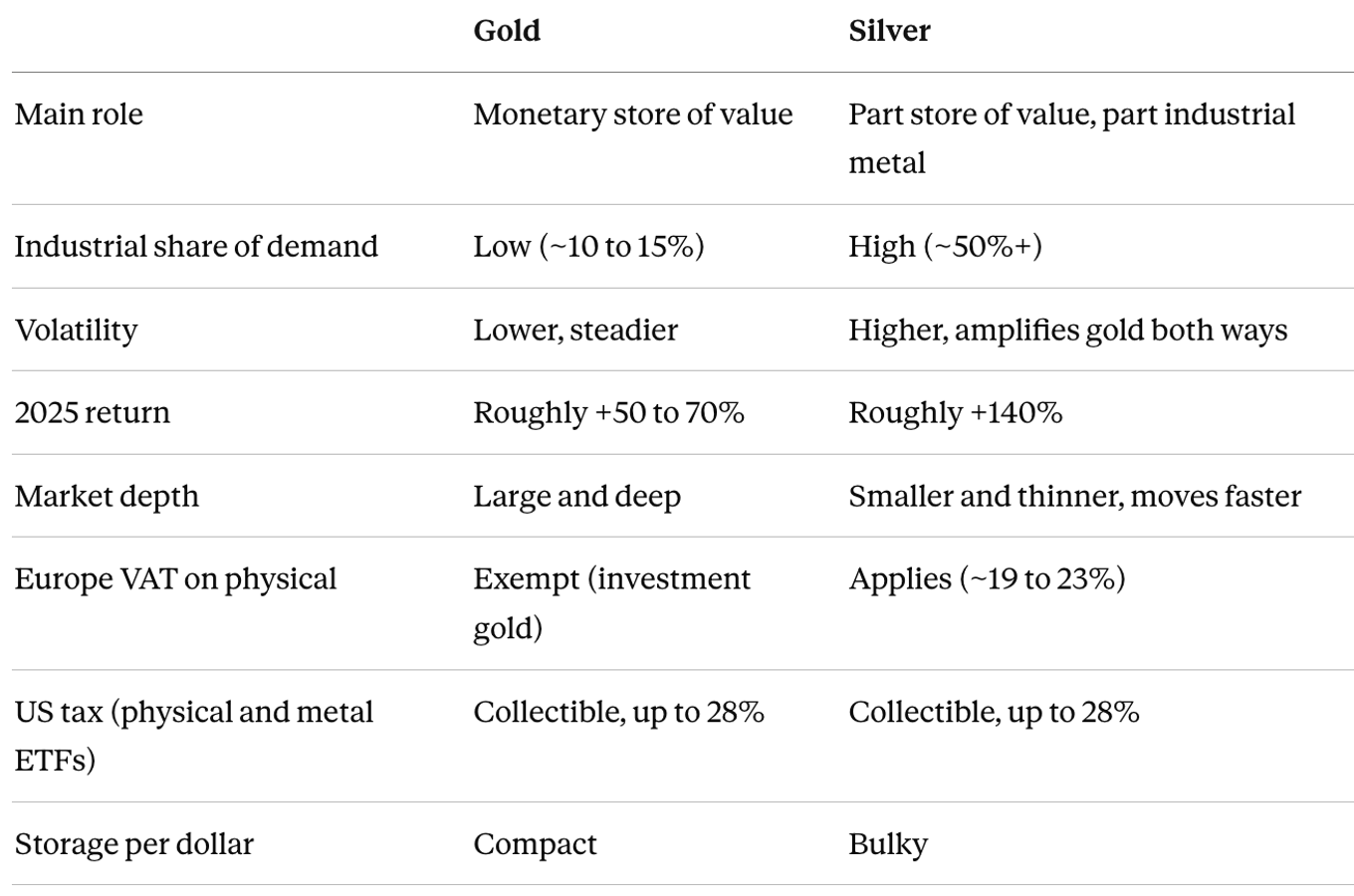
Silver vs Gold: The Honest Comparison
People treat gold and silver as the same trade. They aren't. They rhyme, but they play different roles in a portfolio.
Run the Numbers Before You Buy
Silver's volatility cuts both ways, which makes it exactly the kind of position worth modeling before you commit real money rather than after. That's what the DecentWealth calculators are for:
- The Investment Calculator lets you project how a given allocation grows under different return and contribution scenarios, so you can see what a 5% silver sleeve actually does to your bottom line over ten or twenty years.
- The FIRE and Retirement calculators put that in the context of your bigger number.
Track Silver, Gold, Platinum, and Palladium in DecentWealth v1.3
Here's the part that closes the loop. With the v1.3 update, Gold, Silver, Platinum, and Palladium are now first-class assets in DecentWealth, alongside an expansion to 12 supported languages.
If you hold physical metal as part of a diversified, all-weather portfolio, you no longer have to manage your bullion through awkward workarounds or a manual field that's wrong by lunchtime.
Automatic, hands-off valuations. Enter your holdings once. DecentWealth fetches live spot prices updated every single hour, with no API key to set up, no premium paywall, and no delayed data.
Enter your weight in troy ounces, grams, or kilograms, and the app converts everything under the hood instantly. Given that silver and gold trade at wildly different prices, having the math handled automatically is more useful than it sounds at 11pm when you're adding a tube of coins.
It shows up in your net worth. Your metals populate your portfolio allocation chart as their own distinct categories, sitting cleanly next to your stocks and crypto.
And because silver, platinum, and palladium are taxed differently from gold in most places, seeing each one as its own line rather than a single "metals" blob is exactly the clarity you want come tax season.
Here's the part that matters for how DecentWealth is built. This feature runs on the same privacy-first architecture as everything else in the app. All commodity prices are pulled directly by your device from a public API.
How to See Your Whole Picture in One Place
Whichever route you take, silver rarely lives alone. You've probably got an ETF or ETC in your brokerage, maybe a mining stock or two, a heavy box of coins in a closet, and a crypto wallet doing its own thing in the corner. Several apps and one nagging feeling that you don't know your total net worth number.
That's the problem DecentWealth was built for. It pulls stocks, ETFs, crypto across 16 blockchains, real estate, retirement accounts, cash, and now precious metals into a single view of your net worth on iPhone, iPad, and Apple Watch, in your choice of 45 fiat currencies.
No account and no email needed. Everything lives on your iOS device.
Model the allocation with the calculators first, then download DecentWealth and add your first ounce in under a minute.
________________________________________________________________________________
This article is general information, not personalized investment or tax advice. Silver is volatile, prices move, tax rules vary by country and change over time, and we're a portfolio tracker, not your financial advisor. Do your own homework, and talk to a professional before making decisions about your money.
Frequently Asked Questions
What's new in DecentWealth v1.3?
How do I figure out how much silver to hold?
Can DecentWealth track silver, gold, platinum, and palladium?
How is silver taxed in the US?
Why does physical silver cost more in Europe than gold?
What's the easiest way to invest in silver?
Track your portfolio privately
Stocks, crypto, real estate, and more. No account required.